Modelling in the mathematics curriculum
Antje and David Leigh-Lancaster, Leigh-Lancaster Consulting
Introduction
In Version 9 of the Australian Curriculum: Mathematics, ACARA has made the four mathematical processes more visible by embedding them across the six content strands. This supports students to progressively develop the knowledge, skills and understandings needed to engage in mathematical modelling, computational thinking, statistical investigation, and probability experiments and simulations.
This article provides a snapshot of mathematical modelling. It discusses:
- what mathematical modelling is and why it is worth teaching
- where it sits in the Australian Curriculum: Mathematics
- how it progresses from Foundation to Year 10
- how it can be planned for and taught in the classroom.
What is mathematical modelling?
Mathematical modelling is the process of using mathematics to represent real‑world situations. It reduces complexity by:
- making reasonable assumptions
- choosing variables
- solving problems, and
- interpreting and evaluating results in context.
Often, an initial model is refined to better reflect the situation.
In Version 9 of the Australian Curriculum, ACARA describes mathematical modelling as a five-step process:
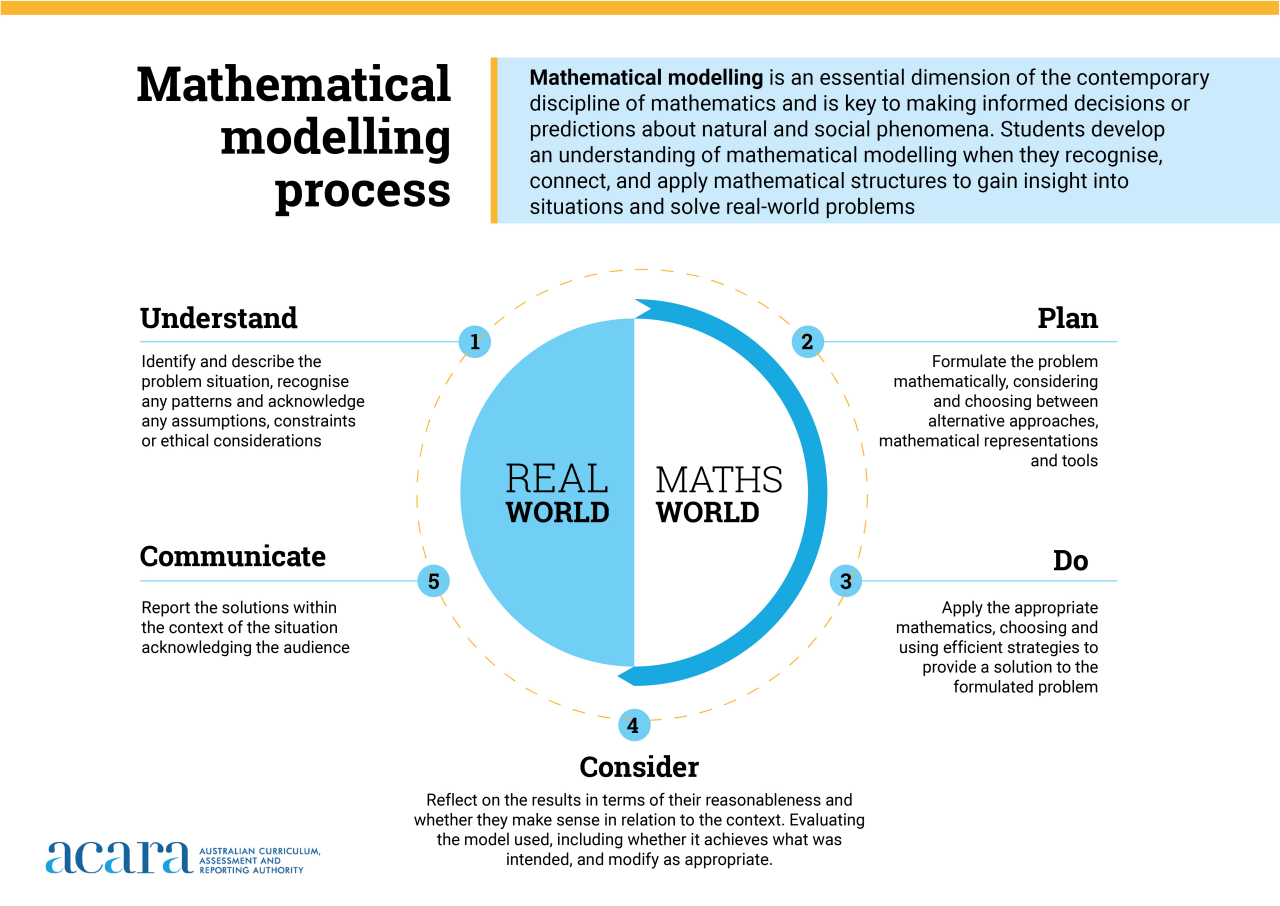
Introductory description (blue box)
Diagram – central labels
REAL WORLD
MATHS WORLD
Step 1 – Understand
Understand
Identify and describe the problem situation, recognise any patterns and acknowledge any assumptions, constraints or ethical considerations.
Step 2 – Plan
Plan
Step 3 – Do
Do
Apply the appropriate mathematics, choosing and using efficient strategies to provide a solution to the formulated problem.
Step 4 – Consider
Consider
Reflect on the results in terms of their reasonableness and whether they make sense in relation to the context. Evaluating the model used, including whether it achieves what was intended, and modify as appropriate.
Step 5 – Communicate
Communicate
Report the solutions within the context of the situation acknowledging the audience.
Organisation branding (bottom left)
ACARA
Australian Curriculum, Assessment and Reporting Authority
The five-steps of the process highlight that mathematical modelling is iterative, requiring students to move between a real-world situation and a mathematical context as they develop, test and refine a model.
A point of distinction
The term mathematical modelling should not be confused with the pedagogical reference to modelling in explicit teaching approaches. In the Australian Education Research Organisation (AERO) guidance resources, modelling refers to the teacher demonstrating and explaining a process, concept, task or behaviour before students practise it with support. Students then progressively move to more independent practice.
Why teach mathematical modelling?
Mathematical modelling provides students with the opportunity to apply their mathematical knowledge in everyday and broader real-world situations, while also consolidating and strengthening their understanding of the mathematics involved. It helps students see mathematics as a tool for understanding and making decisions about the world around them.
At an individual level, modelling can support everyday decisions such as:
- working out the quickest way to get to work while keeping costs under $15 per day, or
- comparing optional features in a garden or home renovation by considering their added cost, time and practical value.
Mathematical models are used to inform decisions in many areas of contemporary life.
- Governments use them to predict the effects of policy changes.
- Engineers use them to design and test structures.
- Researchers use them to investigate questions such as how effective a medication is, or how traffic flows through a road network.
Mathematical modelling in the curriculum
The mathematics curriculum includes 18 content descriptions related to mathematical modelling from Foundation to Year 10.
Primary Mathematics curriculum
The Number strand contains all nine primary mathematical modelling content descriptions. The following table provides an overview of the developmental progression of mathematical modelling from Foundation to Year 6, with the focus and key features outlined to illustrate progression.
| Year level | Focus | Key features |
|---|---|---|
|
Foundation |
Representing practical situations |
|
|
Years 1 - 2 |
Solving practical problems through modellings |
|
|
Years 3 - 4 |
Formulating and solving modelling problems |
|
|
Years 5 - 6 |
Managing complexity and justifying decisions |
|
Secondary Mathematics curriculum
The nine secondary mathematical modelling content descriptions sit across the Number, Algebra and Measurement strands. The following table provides an overview of the developmental progression of mathematical modelling from Years 7–10, with the focus and key features outlined to illustrate progression.
| Year level | Focus | Key features |
|---|---|---|
|
Year 7 |
Solving practical problems |
|
|
Year 8 |
Solving practical and applied problems |
|
|
Year 9 |
Solving applied problems involving changes |
|
|
Year 10 |
Modelling growth, decay and scaling |
|
For all 18 mathematical modelling content descriptions, refer to Mathematical Modelling: Content Descriptions in the Australian Curriculum – Mathematics (PDF). (opens in a new window)
Planning for mathematical modelling
Mathematical modelling is best planned deliberately across the year. One effective approach is to include a process‑focused modelling task each term, completed by all classes at a year level, to ensure balanced coverage of the mathematical processes.
The focus of each term’s modelling task will depend on the sequence of content taught. As modelling typically draws on multiple topics, tasks are most effective after key knowledge and skills have been taught. A whole‑school mathematical processes schedule supports coherent coverage of content and contexts, and helps ensure modelling skills develop progressively over time.
The Mathematics Hub provides a collection of mathematical modelling tasks to support planning, refer to Maths Hub Mathematical modelling resources (PDF). (opens in a new window)
Teaching mathematical modelling
Before giving students a mathematical modelling task to complete, they should be familiar with the 5-step mathematical modelling process and understand what each step involves.
As students can find mathematical modelling challenging, it can be helpful to begin by sharing a completed task before students attempt their first modelling task for the year. A gradual release approach, supported by a worked example, can support understanding and confidence.
Use a process that includes:
- introducing a modelling task with a fully worked example that shows all five steps of the modelling process
- briefly talking through the key decisions and reasoning involved
- using a think–pair–share routine for students to discuss how they might approach the task
- discussing the five steps as a class to clarify expectations and common challenges
- asking students to review the worked example, noting strengths, assumptions, and limitations.
Once the worked example has been unpacked, students can move toward greater independence by:
- completing a second modelling task, with greater student input, working on solving the problem together with reduced scaffolding
- asking students to attempt a similar task in small groups provided with targeted enabling and extending prompts.
It’s helpful for teachers to try the task before using it with their students. It provides insight into where students might struggle, how they might tackle the problem and what maths is likely to come up. It also means prompts and extensions can be planned ahead of time rather than on the spot.
Alignment to AERO
In AERO’s model of learning and teaching, mathematical modelling sits most clearly within supported application, after relevant knowledge and skills have been explicitly taught and practised. In this phase students apply and adapt their learning to familiar and unfamiliar tasks, using mathematics to represent real-world situations.
This makes mathematical modelling a useful way to see whether students can transfer their learning beyond routine exercises and use it purposefully in context.