Key considerations when planning a mathematics sequence of learning
Antje and David Leigh-Lancaster, Leigh-Lancaster Consulting
Introduction
This article will:
- discuss the difference between collaborative and distributed planning
- explore when it might be appropriate to use collaborative or distributed planning
- outline key considerations for planning a mathematics sequence of learning.
What is your approach to planning – collaborative or distributed?
Collaborative planning
Collaborative planning involves teachers working together to:
- discuss the key mathematical ideas and skills underlying the content that they expect students to know, understand and be able to complete
- design ways for students to actively engage with and acquire these ideas and skills.
It also includes:
- identifying effective approaches and activities that actively engage students with the focus of a unit of work
- anticipating common misconceptions
- planning for the range of ability levels in the cohort
- selecting assessments that will provide useful evidence of learning.
The benefit of collaborative planning is that it builds collective mathematical and pedagogical knowledge within the team. This in turn increases teachers’ confidence in their ability to deliver the unit, draw out and consolidate the key mathematics to be learned, and support consistent learning experiences for students across classes.
The limitation of collaborative planning is that it requires sufficient, dedicated time for teams to work together in a focused way.
Distributed planning
Distributed planning involves different members of the team planning distinct units, or sections of a unit. These units are shared in a common place for everyone in the team to access.
The benefit of distributed planning is that it can be time efficient and allows planning to be completed independently.
The limitations of distributed planning include a reduced likelihood of consistent learning experiences for students across classes, and fewer opportunities for building collective mathematical and pedagogical knowledge and confidence. There is no guarantee that teachers will take time to familiarise themselves with any unit content that they have not been involved in preparing prior to delivery. Some teachers may also feel reluctant to seek support from colleagues if they are uncertain about aspects of the mathematics content involved.
When might collaborative or distributed planning be suitable?
Collaborative planning is suitable when:
- not all students are making expected progress (including those who need additional support and extension)
- the team includes members who lack confidence in delivering a particular mathematics content area
- limited shared planning documentation is in place or needs updating
- teams are new or less established.
Distributed planning is most suitable when:
- most students are making expected or better progress, and the focus is on refining or extending the unit
- teams are well established, with strong shared planning documentation and agreed approaches
- there is a high level of mathematical content knowledge, pedagogical knowledge and confidence across the team.
When time is constrained and responsibilities need to be shared efficiently, an effective option can be to implement a combination of the two planning approaches. For instance, a distributed planning approach can be used to draft the initial sequences of learning. Then the team can come together collaboratively to discuss and review each sequence in detail, ensuring all team members feel confident in the underlying mathematical ideas and approaches, and in delivering the content.
Key considerations when planning a sequence of learning for mathematics
Planning a mathematics sequence of learning involves translating content descriptions (what to teach) and achievement standards (what students should achieve) into a sequenced, teachable unit.
Documents you can draw on for your planning:
- your school’s year-level plan, outlining the areas of mathematics to be taught across the year
- the Australian Curriculum: Mathematics
- scope and sequence of content descriptions.
Example: outline for a Year 7 sequence of learning on linear patterns
Review the selected content descriptions, elaborations and associated achievement standard to determine the breadth and depth of content to be covered.
Content descriptions
- Generate tables of values from visually growing patterns or the rule of a function; describe and plot these relationships on the Cartesian plane. (AC9M7A05 (opens external website in a new window))
- Manipulate formulas involving several variables using digital tools and describe the effect of systematic variation in the values of the variables. (AC9M7A06 (opens external website in a new window))
These two content descriptions complement each other, supporting students to progress from specific linear rules to a more generalised form.
Related aspects of the achievement standard
Students solve linear equations with natural number solutions. They create tables of values related to algebraic expressions and formulas and describe the effect of variation.
Key ideas, skills and vocabulary to be developed
Key ideas and understandings
Linear patterns:
- can be represented using a table of values, rule or graph
- have a constant difference between consecutive values
- result in an increasing or decreasing straight line when graphed, depending on the sign of the constant difference
- can be described using a rule of the form:
- (Output) = constant difference × (Input) + starting number
- where 'starting number' refers to where the graph intercepts the y-axis at x=0. Students may need to work backwards in the table of values to determine its value
- progress to the general rule y = mx + c once students demonstrate a sound understanding of variables.
Understand how the constant difference and starting number affect the shape of a graph.
Skills
- Determine whether a pattern is linear or not
- Identify the constant difference and starting number for a linear pattern
- Given a visual growing linear pattern, represent it using a table, rule and graph (with and without use of graphing software)
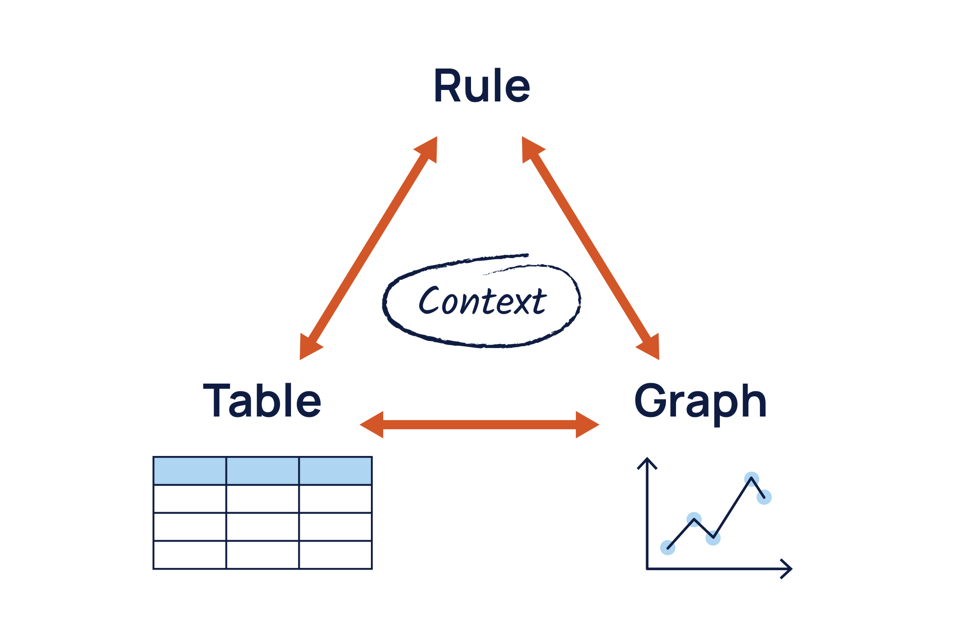
- Given the rule of a linear pattern, sketch an approximate graph by hand (focus is on identifying key features: increasing/decreasing, steepness, rather than plotting points on the Cartesian plane)
- Use graphing technology to explore systematic variation in constant difference and starting number and observe the effect on the graph
Vocabulary
Constant difference, consecutive, decreasing, gradient, increasing, intercept, slope, starting number, steepness, variable
Common activities
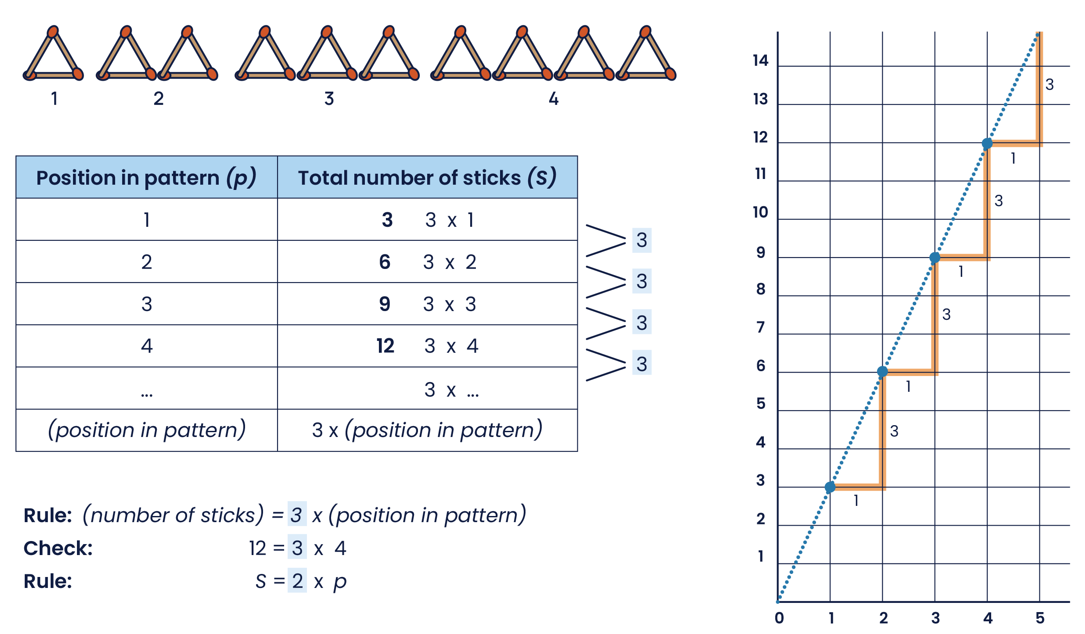
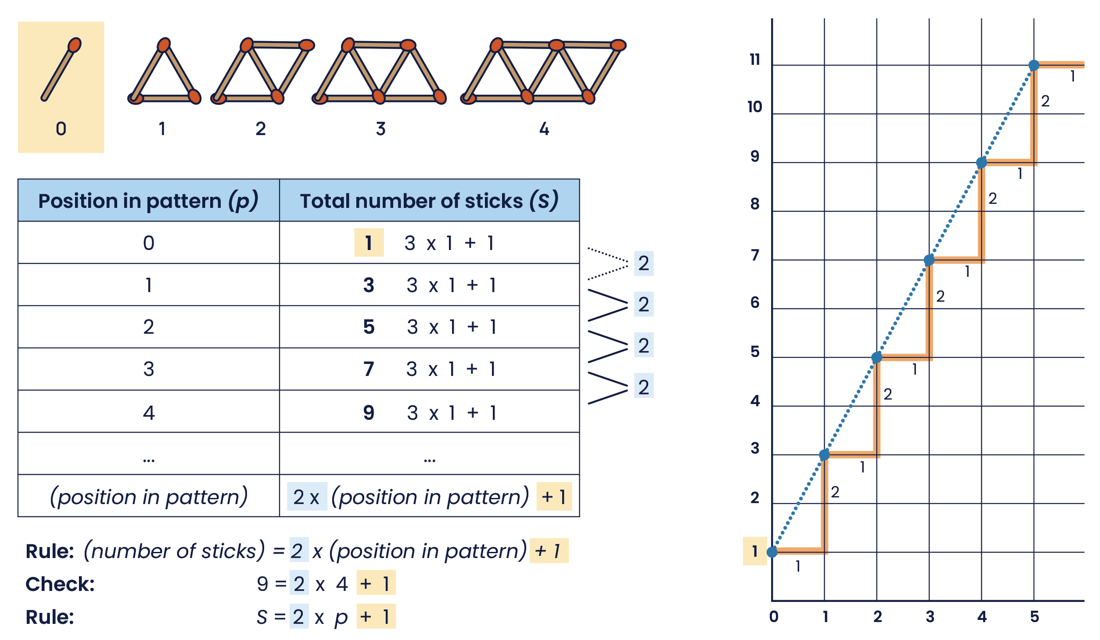
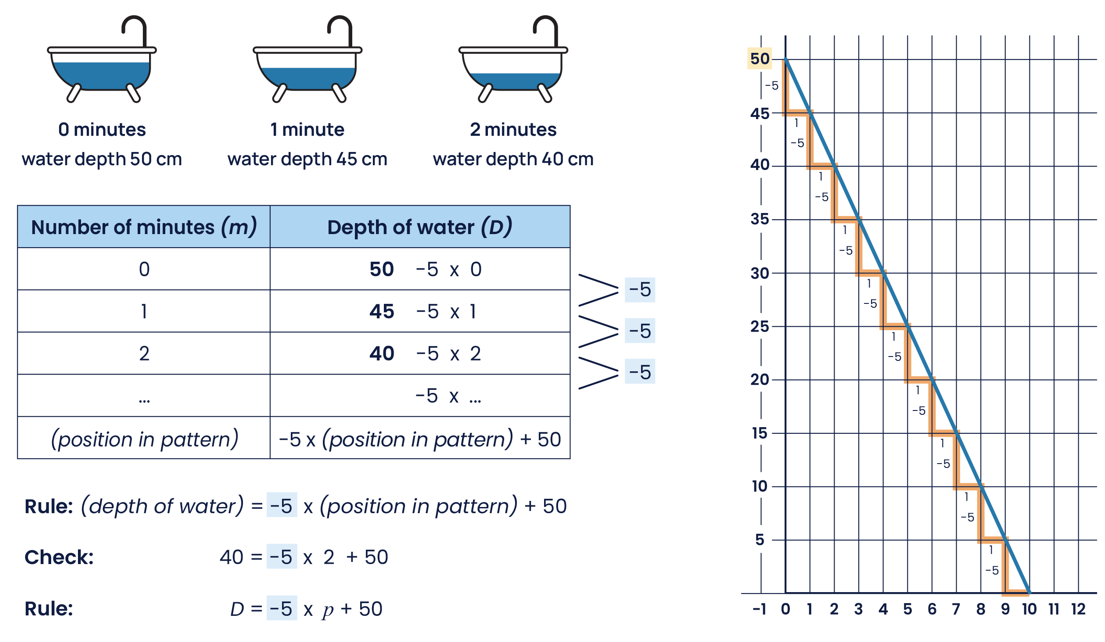
These examples highlight how the constant difference and starting number (including when it is 0) are shown across different representations of the same linear pattern.
1. Starting number is zero
The pattern is shown as: (1) a visual matchstick pattern, (2) a table of values, and (3) a graph.
2. Starting number is not zero
The pattern is shown as: (1) a visual matchstick pattern, (2) a table of values, and (3) a graph.
3. The gradient is negative
In this example the bath water decreases at a rate of 5cm per minute, resulting in a negative gradient that is represented in both the graph and the table.
Focus points
Students demonstrate their ability to continue the pattern using manipulatives, drawing and completing the table of values for 3 more terms in the given pattern.
Focus on the following:
- Start by using words for variables when writing the rule. This helps to avoid a common misconception where students interpret the symbolic representation as an object (for example, interpreted incorrectly as representing 3 sticks, rather than 3xS, where S is an unknown number of sticks).
- Support students to connect how the constant difference appears in the three representations for each pattern. ‘For example, have them add 3 sticks to the next pattern in the sequence, and identify a constant difference of 3 in consecutive rows of the table, the rule S=3P when the graph has a gradient of 3.’?
- Use graphing software to develop understanding of how the values of the constant difference and starting number affect the graph.
- Explore some non-linear patterns, for instance the relationship between the side length of a square and its area.
Prior knowledge
Consider the prior knowledge required for the lesson. For example, in this lesson:
- recognise and continue a pattern
- complete a table of values for a given pattern
- plot points on the Cartesian plane (at least first quarter)
- substitute values into a given rule with natural number solutions.
This sequence of learning builds on key prior knowledge from Year 6 and connects to several Year 7 Algebra content descriptions. The following curriculum links help clarify the progression of understanding across the unit:
- Year 6 Algebra: recognise and use rules that generalise visual growing patterns and number patterns involving rational numbers (AC9M6A01 (opens external website in a new window)).
- Year 7 Algebra: content descriptions including AC9M7A01 (opens external website in a new window), AC9M7A02 (opens external website in a new window), AC9M7A03 (opens external website in a new window), AC9M7A04 (opens external website in a new window).
Additional considerations to include
- Specific cohort needs
- Additional support and enrichment
- Common errors or misconceptions
- Common assessment tasks
Next steps
Development of lesson plans. Break down the content into manageable learning chunks and write associated learning intentions and success criteria for each lesson.
Leadership support
Planning for mathematics curriculum implementation is central to effective, whole-school teaching and learning. It involves coherent planning at four levels of detail: whole-school, year level, unit/topic and lesson level.
Planning enables a school to:
- evaluate its effectiveness over time and adjust priorities
- know whether the curriculum has been taught in a logical, connected sequence
- build shared mathematical content knowledge, pedagogical approaches and a common language
- align assessment across classes for consistency and fairness
- use evidence of student learning to refine teaching, planning and targeted support.
The process of developing, refining and revising planning documentation is an ongoing task that requires dedicated time and resources. Leaders play a crucial role in setting clear expectations for planning, protecting time for teams to collaborate, and highlighting that the refining of sequences in response to evidence of student learning is an important part of ongoing practice.