
Please note: This site contains links to websites not controlled by the Australian Government or ESA. Read more in the Terms of Use.
Let's party!
Students understand and compare data, grasp the notion of budgeting and appreciate how needs and wants vary between people and cultures.
- Resource details
- Year level
- Year 4
- Purpose
- Teaching resource Teaching strategies
- Strand
- Number
- Topic
- Mathematical modelling Money and financial mathematics
- Audience
- Teachers
- Format
- Downloadable resource
- Numeracy progression
- Additive strategies (P8) Multiplicative strategies (P6) Understanding money (P7)
- Publisher
- ASIC
- Copyright
- © ASIC. Creative Commons BY-NC-SA 3.0 AU.
- Keywords
- financial literacy
- Other terms
- budgeting diversity inclusive
Related resources
-
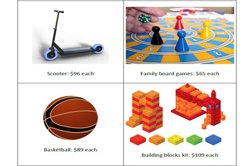
Mathematical modelling: Year 4 – planning tool
This planning resource for Year 4 is for the topic of Mathematical modelling.
Resource details -
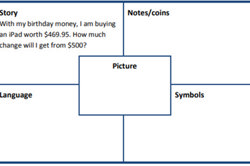
Tuckshop orders
Students make calculations with money.
Resource details -
Bright budgeting
Students create budgets and financially plan for authentic real-life experiences. They calculate tax and percentage discounts on goods.
Resource details -
Paying It Forward
Paying It Forward is a free teaching resource written by Australian primary school teachers for teachers.
Resource details -
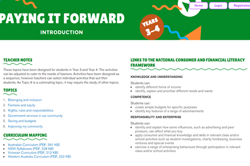
Paying It Forward (Years 3-4)
In this unit, students develop financial literacy skills, including an understanding of the costs and benefits of saving and spending and strategies that can be used to reach financial goals.
Resource details -
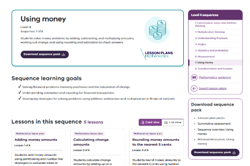
Using money (5 lessons)
In this sequence of 5 lessons, students solve money problems by adding, subtracting, and multiplying amounts, working out change, and using rounding and estimation to check answers
Resource details -

Pocket money: Mathematical modelling
In this second of three lessons, students use mathematical modelling to solve problems that involve financial decisions. They will be guided to use the 4-step problem solving model to support them to unpack the problem, generate a plan to help solve it, and check their ability to work mathematically.
Resource details