Buying presents
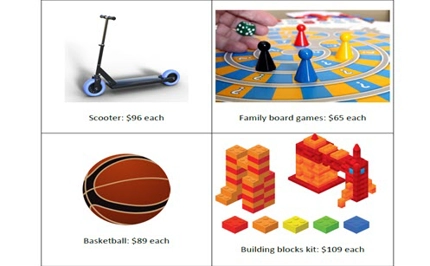
In this lesson, students will use mathematical modelling to make decisions based on the purchasing of gifts. Students will explore different ways to estimate and form possible options for purchasing, ensuring they do not go over budget.
- Resource details
- Year level
- Year 4
- Purpose
- Teaching resource
- Strand
- Number
- Topic
- Mathematical modelling
- Audience
- Teachers
- Format
- Webpage
- Australian Curriculum code
- AC9M4N08
- Numeracy progression
- Multiplicative strategies (P6, P7) Additive strategies (P8) Understanding money (P7)
- Publisher
- Commonwealth of Australia
- Copyright
- © 2024 Commonwealth of Australia. Creative Commons BY 4.0.
- Other terms
- financial maths Maths Hub lesson plan
Related resources
-
Mathematical modelling: Year 4 – planning tool
This planning resource for Year 4 is for the topic of Mathematical modelling.
Resource details -
Let's party!
Students learn about needs and wants while budgeting for a birthday party.
Resource details -
Paying It Forward
Paying It Forward is a free teaching resource written by Australian primary school teachers for teachers.
Resource details -
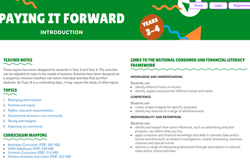
Paying It Forward (Years 3-4)
In this unit, students develop financial literacy skills, including an understanding of the costs and benefits of saving and spending and strategies that can be used to reach financial goals.
Resource details -
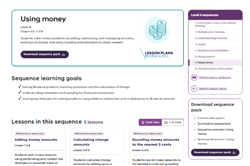
Using money (5 lessons)
In this sequence of 5 lessons, students solve money problems by adding, subtracting, and multiplying amounts, working out change, and using rounding and estimation to check answers
Resource details -

Pocket money: Mathematical modelling
In this second of three lessons, students use mathematical modelling to solve problems that involve financial decisions. They will be guided to use the 4-step problem solving model to support them to unpack the problem, generate a plan to help solve it, and check their ability to work mathematically.
Resource details -
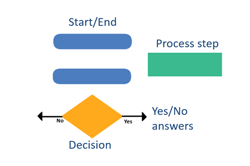
Developing flowcharts: Halving strategy
In this lesson, students will create a flowchart outlining the sequence of steps required when using the halving strategy for division. The process of creating the flowchart consolidates the sequential steps required when solving problems and can be found in other learning areas, such as Design and Technologies and Digital Technologies.
Resource details