
Please note: This site contains links to websites not controlled by the Australian Government or ESA. Read more in the Terms of Use.
reSolve: Authentic problems – what's for lunch?
This sequence of four lessons invites students to investigate how many of a chosen food item are eaten at their school in a year. Students identify the mathematical knowledge they need to find how many of the selected items they eat in a year and devise a plan to find the total number, using grouping, partitioning and repeated addition strategies. They share strategies and methods and reach consensus about the most efficient strategies to use. Each lesson is outlined in detail including curriculum links, vocabulary, materials needed, sample answers, discussion points and student resources. This sequence is part of the reSolve: Mathematics by Inquiry special topic 'Authentic Problems'.
- Resource details
- Year level
- Year 2
- Purpose
- Teaching resource
- Strand
- Number Statistics
- Topic
- Addition and subtraction Multiplication and division Operating with number Data representation and interpretation Place value
- Audience
- Teachers
- Format
- Downloadable resource
- Numeracy progression
- Number and place value (P5) Additive strategies (P7) Multiplicative strategies (P5) Interpreting and representing data (P3)
- Publisher
- reSolve Maths by Inquiry
- Copyright
- © Australian Government Department of Education, Skills and Employment 2021. Creative Commons BY-NC-SA 4.0.
- Keywords
- data counting mental strategies
- Other terms
- addition written calculations
Related resources
-
Place value: What’s in a number?
Students sort and describe one-, two- and three-digit numbers using correct terminology and Venn diagrams to identify patterns and generalisations.
Resource details -
Multiplicative thinking - Level 2
Multiplicative thinking - Level 2
Resource details -
Multiplication sequence - Level 2, 3, 4, 5, 6
Multiplication sequence - Level 2, 3, 4, 5, 6
Resource details -
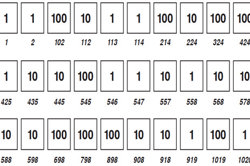
reSolve: Place value cards
Two inquiry-based lessons exploring place value and different ways to represent numbers.
Resource details -
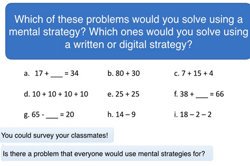
Which would you do in your head?
This video examines different ways of solving addition and subtraction problems.
Resource details -
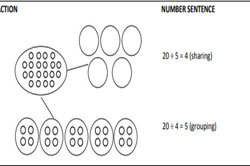
How many clumps?
This series of lessons develops students' skills, knowledge and processes of multiplicative thinking, incorporating a First Nations perspective.
Resource details -
Additive thinking - Level 2
This sequence of 11 lessons is designed to build proficiency in addition and subtraction through interactive activities, games, and problem-solving tasks.
Resource details -
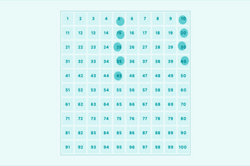
Number sequence: Year 2 – planning tool
This planning resource for Year 2 is for the topic of Number sequence.
Resource details