
Please note: This site contains links to websites not controlled by the Australian Government or ESA. Read more in the Terms of Use.
Indigenous Ecological Knowledge and celestial objects
Students investigate how Aboriginal and Torres Strait Islander Peoples use the stars and moon to understand seasonal changes, and plant and animal behaviours, strengthening connections to Country.
- Resource details
- Year level
- Year 5
- Purpose
- Teaching resource
- Strand
- Measurement Number Statistics
- Topic
- Mathematical modelling Statistical investigations
- Audience
- Teachers
- Format
- Webpage
- Numeracy progression
- Positioning and locating (P5)
- Publisher
University of Melbourne
- Copyright
© The University of Melbourne – Ngarrngga, 2026. Free-for-education.
Related resources
-
Stellar navigation and mathematics
Students will learn about celestial positions, the azimuth and altitude to shape their understanding of traditional navigational techniques.
Resource details -
Statistics: Time to play
Statistics: Time to play
Resource details -

Mathematical modelling: Year 5 – planning tool
This planning resource for Year 5 is for the topic of Mathematical modelling.
Resource details -
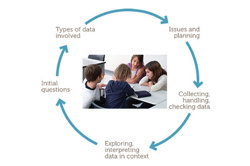
Conduct statistical investigations: Year 5 – planning tool
This planning resource for Year 5 is for the topic of Conduct statistical investigations.
Resource details -

Owning a pet
Students learn about pet ownership in Australia and the cost of buying and keeping a pet.
Resource details -
Paying It Forward
Paying It Forward is a free teaching resource written by Australian primary school teachers for teachers.
Resource details -
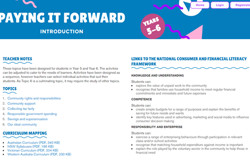
Paying It Forward (Years 5-6)
In this unit, students will understand how taxation is collected and how it is spent responsibly to provide for all members of the community. They will also learn the value of short-term sacrifices for long-term gain and further develop strategies for short- and long-term financial planning.
Resource details