
Please note: This site contains links to websites not controlled by the Australian Government or ESA. Read more in the Terms of Use.
2-dimensional shapes inquiry
This sequence of lessons requires the use of formulas to solve problems involving the circumference and area of shapes. Students will work in teams to determine lines of symmetry of a rectangle compared to a square, while also determing whether a right angle is acute, obtuse or neither. The proceeding lessons focus on students developing claims to support their findings, which are accompanied by annotated student examples.
- Resource details
- Year level
- Year 8
- Purpose
- Assessment tasks Assessment advice Disability and inclusive education Student activities Teaching resource Teaching strategies
- Strand
- Space Measurement
- Topic
- Angles and geometric reasoning Area, volume and surface area Operating with number Pythagoras and trigonometry Length Shapes and objects
- Audience
- Students Teachers
- Format
- Downloadable resource
- Australian Curriculum code
- AC9M8M03
- Numeracy progression
- Understanding units of measurement (P9)
- Publisher
- Inquiry Maths
- Copyright
- © Andrew Blair 2012-21. Creative Commons BY-NC-SA 4.0.
- Keywords
- angle interior angle quadrilateral radius diameter
- Other terms
- regular shape polygon
Related resources
-
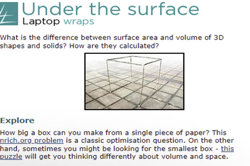
Under the surface
What is the difference between surface area and volume of three-dimensional shapes and solids?
Resource details -
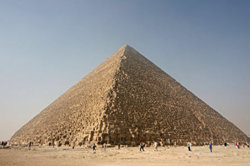
Pyramid inquiry
Using rules to determine the area, perimeter and height of pyramids, while also becoming aware of the features of pyramids.
Resource details -
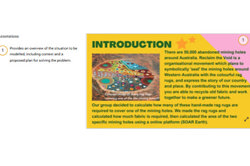
WS06 - Reclaim the void
Use this work sample to assess students' knowledge and skills to use mathematical modelling to solve a real world problem.
Resource details -
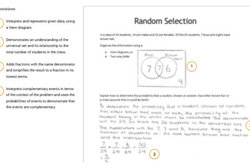
WS02 - Random selection
Use this work sample to assess students' knowledge and skills in investigating possible outcomes of events.
Resource details -
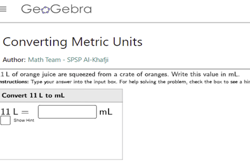
Converting metric units
Use this to have students practise converting units.
Resource details -
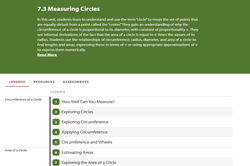
Measuring circles
This unit consists of several lessons that introduce the geometry of circles.
Resource details -
reSolve: Mechanical linkages – quadrilaterals
This unit focuses on investigating geometry, starting with real-life objects, then making working models and finally using pre-prepared dynamic geometry software.
Resource details -
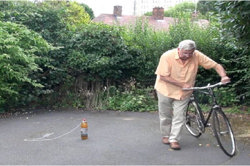
reSolve: Mathematical modelling – cornering
This series of inquiry-based lessons uses properties of circles, trigonometry and Pythagoras' theorem to investigate how long vehicles 'cut corners' when cornering.
Resource details