
reSolve: Mathematical modelling – cornering
This unit is about the way in which long vehicles, such as buses, turn corners. Students start with paper scale models, experiment with a bike, then use pre-made dynamic geometry programs that highlight the geometric features of cornering, considering the vehicles’ width and front and back overhangs. They prepare a road safety presentation and a report to council about road design.
- Resource details
- Year level
- Year 8 Year 9
- Purpose
- Teaching resource
- Strand
- Space
- Topic
- Pythagoras and trigonometry Angles and geometric reasoning
- Audience
- Teachers
- Format
- Downloadable resource
- Numeracy progression
- Understanding geometric properties (P7) Understanding units of measurement (P10) Multiplicative strategies (P9) Proportional thinking (P7)
- Publisher
- reSolve Maths by Inquiry
- Copyright
- © Australian Government Department of Education, Skills and Employment 2021. Creative Commons BY-NC-SA 4.0.
- Keywords
- circle angle
Related resources
-
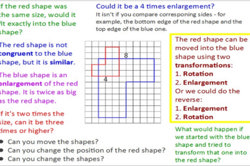
Enlargement
To enlarge and transform geometrical shapes.
Resource details -
Mathematical modelling: The steepest slopes on Baldwin St
Students investigate steepness using Baldwin Street, representing gradient in multiple ways, linking it to tangent, and communicating findings for real audiences.
Resource details -

Pyramid inquiry
Using rules to determine the area, perimeter and height of pyramids, while also becoming aware of the features of pyramids.
Resource details -
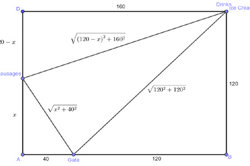
reSolve: Geometry – lunch lap (Trial)
Two inquiry-based lessons where students are challenged to use Pythagoras' theorem to optimise the path of a lunch cart.
Resource details -
reSolve: Mechanical linkages – quadrilaterals
This unit focuses on investigating geometry, starting with real-life objects, then making working models and finally using pre-prepared dynamic geometry software.
Resource details -
Similar triangles
This resource provides an explanation of the rules for triangles to be similar. The resource includes downloadable worksheets for students.
Resource details -
Similarity
This resource focuses on the rules for similarity and the transformation of enlargement, with detailed explanations, worked examples and assessment questions.
Resource details