Retrieval practice
Antje and David Leigh-Lancaster, Leigh-Lancaster Consulting
Introduction
Retention, retrieval, recall and fluency are terms we hear often in education, especially when we’re discussing how students access and use prior learning. But what do these terms actually mean, and how do they relate to effective classroom practice?
This article will:
- clarify the terms retention, retrieval, recall and fluency
- address common misunderstandings
- outline key features of effective retrieval practice, with practical examples.
How do recall, retrieval and retention connect?
Retention, retrieval, and recall each describe a different part of how learning is accessed and strengthened over time. The diagram below provides a simple outline of their relationship.
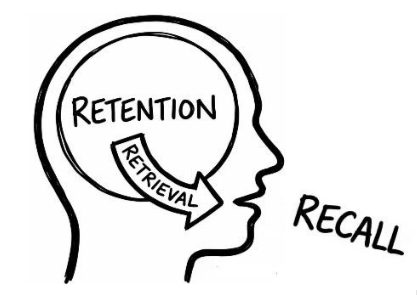
Image: Relationship between retention, retrieval and recall
Retention, retrieval and recall are related but distinct aspects of how students access and strengthen learning over time.
- Retention is the persistence of learning over time.
- Retrieval is the process of accessing knowledge from long-term memory.
- Recall is the result of retrieval of previously learned knowledge (facts, concepts or procedures) so it can be used to understand, choose an approach or solve a problem.
Retrieval practice strengthens retention by requiring students to access learning from long-term memory. When learning is retained, students are more likely to recall it when needed and apply it fluently across familiar and unfamiliar mathematical tasks.
In the Australian Curriculum: Mathematics, fluency is described as follows:
Mathematics provides opportunities for students to develop, practise and consolidate skills; choose appropriate procedures; carry out procedures flexibly, accurately, efficiently and appropriately; and apply knowledge and understanding of concepts readily. Students are fluent when they connect their conceptual understanding to learned strategies and procedures; choose and use computational strategies efficiently; when they recognise robust ways of answering questions; when they choose appropriate representations and approximations; when they understand and regularly apply definitions, facts and theorems; and when they can manipulate mathematical objects, expressions, relations and equations to find solutions to problems.
(ACARA 2022)
Some common misunderstandings
Retention, retrieval and recall can be interpreted narrowly at times, limiting the breadth, depth and impact of retrieval practice. The table below outlines some common misunderstandings of each term or concept.
| Term | Common misunderstandings |
|---|---|
| Retention |
|
| Retrieval |
|
| Recall |
|
| Fluency |
|
Retrieval practice
Retrieval practice is the intentional use of activities that require students to mentally ‘search’ for previously learned information and bring it into active thinking. This effort strengthens memory over time, making learning more likely to be retained and easier to apply in both familiar and unfamiliar contexts.
Effective retrieval practice should:
- create productive challenge (desirable difficulty) – so it’s effortful enough to require thinking, while still being achievable
- go beyond facts – including prompts that build from the recall of key information to questions that explore relationships, methods and reasoning (the ‘how’ and ‘why’)
- vary the prompts and contexts –with different question types and representations so students retrieve and apply learning in multiple ways, not just in one repeated format
- be brief and routine – occurring regularly as a short part of lessons so that prior learning is revisited, without taking up too much teaching time
- ensure high participation – using whole-class response modes (such as mini-whiteboards and quizzes) to ensure all students are actively thinking and responding, not just a few
- use low-stakes tasks and feedback – reducing anxiety and keeping the focus on learning rather than performance; using timely feedback to help identify errors or misconceptions early, so these are not reinforced through repeated practice
- require an independent attempt first – giving students time to retrieve from memory before answers are provided, rather than re-exposing the learning through re-reading or explanation.
Examples of retrieval practice questions
Look at the following three questions and consider how their structure encourages effortful thinking and recall.
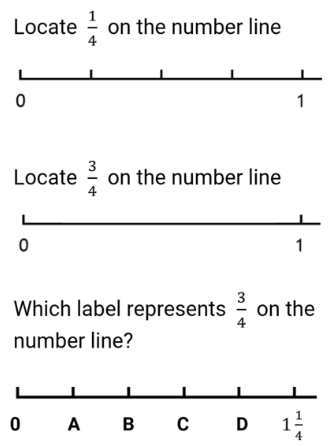
Question 1
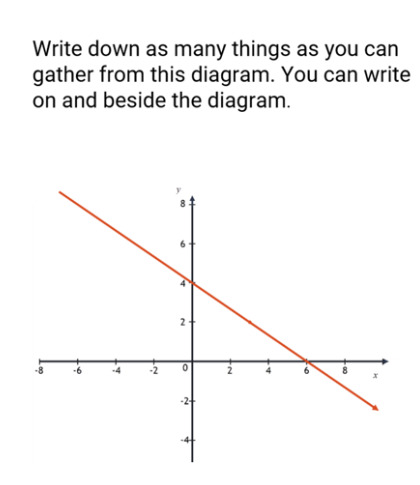
Question 2
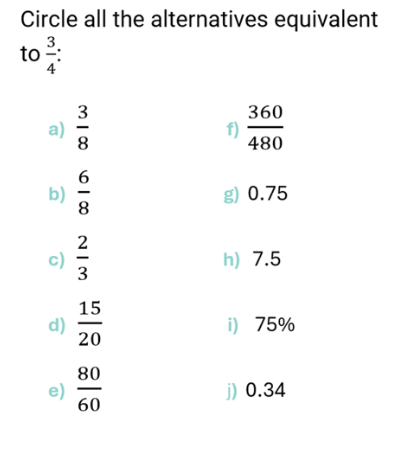
Question 3
Question 1 is an effective retrieval task because it progressively removes scaffolds, requiring students to shift from simple recognition to active recall. Including progressively more challenging questions helps reveal students’ depth of understanding by showing what they can recall and apply as prompts are reduced.
Question 2 is open ended, encouraging students to retrieve and apply prior learning from different areas of mathematics (such as gradient, intercepts, linear graphs, Pythagoras, triangles – perimeter, area). This strengthens connections across different topics and consolidates knowledge, while supporting students to sort, organise and show what they know.
Question 3 combines numbers from three different areas (fractions, decimals and percentages), requiring students to retrieve and apply knowledge across representations. This supports students to strengthen connections across topics and consolidate learning. As students don’t know how many correct alternatives there are, an additional benefit is that all possibilities need to be considered.
These examples highlight how retrieval practice can be designed to strengthen recall, reveal understanding, and build flexible connections across mathematical ideas. Each question structure can be readily adapted to different topics, levels and student needs.
Effective retrieval practice does not rely on one-off activities, but on consistent routines that are designed, reviewed and improved over time. When teachers use student responses to adjust questions, revisit key learning and refine lesson sequences, retrieval practice becomes a practical tool for strengthening long-term retention and supporting fluent application of learned strategies and procedures in mathematics.