Making connections in and across strands to strengthen understanding
Antje and David Leigh-Lancaster, Leigh-Lancaster Consulting
Introduction
The Australian Curriculum: Mathematics uses six interrelated strands to progressively develop key concepts, skills and processes from simple to more advanced throughout the years of schooling.
There are natural connections between content of the strands, which teachers can use to revisit and deepen students’ understanding, link ideas, and provide contexts for introducing or applying various topics in mathematics.
This article discusses:
- how explicitly addressing content from more than one strand within an activity can strengthen connections and deepen understanding
- how understanding the progression of concepts within a strand can support learning.
Combining content from two or more strands
Pythagoras' theorem is introduced at Year 8 and provides a good example of how content from the Measurement, Algebra, Number and Space strands can be covered in activities related to the same context.
This table outlines some common concepts and skills that can be addressed through problems related to Pythagoras' theorem.
|
Strand |
Concept, knowledge, skills |
|
Measurement |
|
|
Algebra |
|
|
Number |
|
|
Space |
|
The following example incorporates some of these elements:
How much cabling is required to support a pole?
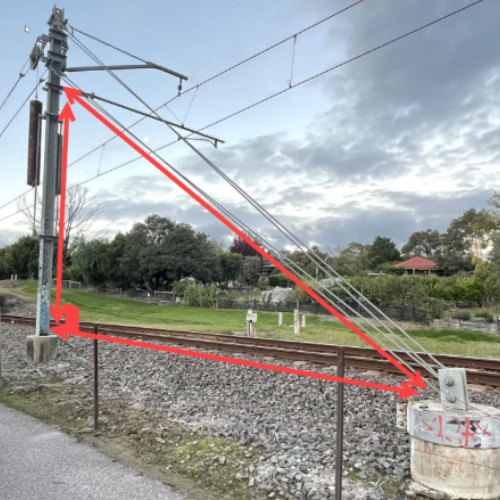
Figure 1: Cables used to support a pole
Some possible examples of cross-strand connections
Students could find the concept of ratio and proportion challenging because:
- it requires multiplicative thinking
- it involves different representations
- comparisons can be part– whole or part-part.
This content can be made more accessible by explicitly identifying applications across a range of related practical contexts:
- scale and similarity
- gradient
- unit price
- percentage increase/decrease
- relative frequencies
- comparisons.
The concept of ratio and proportion connects Number to other strands such as Algebra, Measurement, Probability, Space, and Statistics.
- Probability provides an opportunity to use equivalent forms of rational numbers (fractions, decimals and percentages) in authentic contexts to express the likelihood of chance events as long-run experimental frequency or expected values.
The concept of chance connects the Probability strand with Number and Statistics.
- The use of multiplying and dividing by powers of 10 in Number has applications to conversion between units in metric measurement, understanding place value, representing decimal numbers in exponential form, scientific notation and logarithmic scales.
The concept of powers connects Number with Measurement and Algebra.
Understanding the progression of concepts to support learning
One of the key benefits of understanding the progression of core concepts across year levels is that it enables teachers to support student learning grounded in knowledge of where a concept has evolved from, where it goes and what it subsequently relates to.
Consider the development of the concept of a variable from Foundation to Year 7. One of the reasons some students find this challenging is that two sequences of core concepts have been developed alongside each other:
- finding unknowns and solving equations (focus on specific answers)
- patterns and relationships (focus on generalising).
The following table shows how these two sequences evolve from Foundation to Year 7 demonstrating the key aspects of the content descriptors for the strand Algebra.
|
Unknowns and solving equations |
Patterns and relationships |
|
Foundation – Year 2
Developing number sense.
|
Foundation – Year 2
Associating an object with a number to represent a quantity and working with patterns. |
|
Years 3–5
□ + 14 = 64 + 20 3 × 5 = 30 ÷ □ These problems involve finding a single unknown value. |
Years 3–5
□ × 4 to generate 4, 8, 12 … Discerning underlying structure. |
|
Year 6
25 + Δ = 3 x □ These problems involve finding pairs of unknown values.
|
Year 6
Introduction to the concept of variable. |
|
Year 7
6x + 8 = 38 or finding the length of a rectangle when given the area and width A = l × w These problems involve finding a solution with respect to a specified variable.
|
Year 7
Using variables to connect relationships using tables, graphs and rules. |
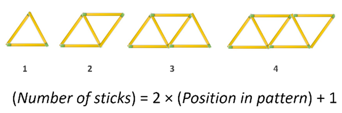
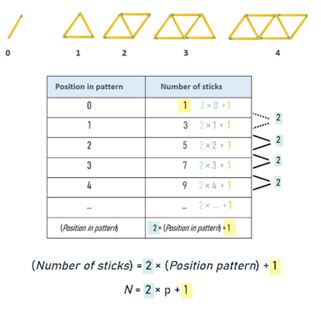
After spending time completing number sentences and finding unknown values, students may initially struggle to understand that a variable can both take specific values and can also be used as a placeholder to represent a general value in a pattern or a rule.
Being clear about these two sequences, and how they develop and interrelate across the years, enables teachers to:
- recognise why some students might be struggling and where they could benefit from additional explanation
- highlight the different roles of variables as unknowns and generalisers, and how the corresponding processes and skills are used for distinct problem-solving and modelling purposes.
Find more about connections in and across strands and how they can help to strengthen understanding:
- Education Services Australia: reSolve: Quarter Cartons (mathematicshub.edu.au)
This activity draws on content from the Algebra, Number, Measurement and Space strands in a practical design context involving surface area and volume of prisms.
- The role of variables in relational thinking: an interview study with kindergarten and primary school children | ZDM – Mathematics Education (springer.com) [Open access, last viewed 28/10/25]
This paper discusses process and structural aspects of the notion of variable in Foundation – Year 6.
- Progression of maths topics in the Australian Curriculum: Foundation – Year 6 and Progression of maths topics in the Australian curriculum Years 7–10
These documents outline sequences of progression of mathematical concepts for related content descriptions in a strand across year levels.