
Please note: This site contains links to websites not controlled by the Australian Government or ESA. Read more in the Terms of Use.
reSolve: Quarter cartons
This lesson challenges students to use algebra and proportional reasoning to investigate how changing the size of a paper square or rectangle impacts the dimensions of a box folded from that paper. Students apply knowledge about nets of 3D objects and explore algebraic relationships through a set of hands-on activities making origami boxes. The context of paper folding encourages students to physically manipulate objects to investigate relationships and demonstrate their findings. The sequence could serve as an introduction to geometric proofs. Each lesson is outlined in detail including curriculum links, vocabulary, materials needed, sample answers, discussion points and student resources. This sequence is part of the reSolve: Mathematics by Inquiry program.
- Resource details
- Year level
- Year 8
- Purpose
- Teaching resource
- Strand
- Algebra Space
- Topic
- Proportion, rates and ratios Patterns and algebra Algebraic expressions Area, volume and surface area
- Audience
- Teachers
- Format
- Downloadable resource
- Numeracy progression
- Understanding units of measurement (P9) Understanding geometric properties (P6) Number patterns and algebraic thinking (P7)
- Publisher
- reSolve Maths by Inquiry
- Copyright
- © Australian Government Department of Education, Skills and Employment 2021. Creative Commons BY-NC-SA 4.0.
- Keywords
- factors area volume prism nets scale
- Other terms
- origami
Related resources
-
Graphical representations of linear equations
Students explore linear relationships through sequences, graphs, and equations, building understanding of positive and negative patterns.
Resource details -
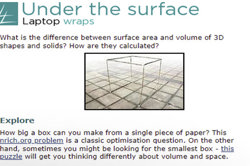
Under the surface
What is the difference between surface area and volume of three-dimensional shapes and solids?
Resource details -
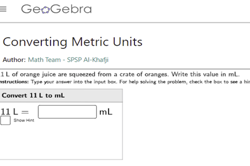
Converting metric units
Use this to have students practise converting units.
Resource details -
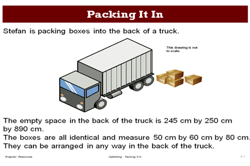
Packing a truck
This task asks students to pack a truck with boxes in an efficient way. The resource includes a lesson plan and sample student work.
Resource details -
Volume of prisms
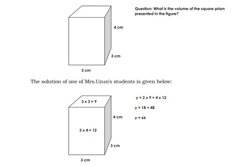
This resource, focusing on the volume of rectangular prisms and the units of capacity, gives detailed explanations of the curriculum content, worked examples and assessment questions.
Resource details -
Quarter cartons
This resource looks at the effect changing a dimension of a box has on the volume and surface area of the box. Students use algebra for this investigation but it can also be used to look at the units of measurement used.
Resource details -
Surface area and volume of prisms and cylinders
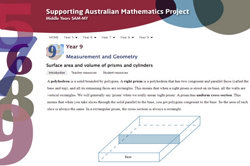
This resource discusses the volume of a rectangular prism and how the units of volume and capacity are related.
Resource details -
Rectangle ratios inquiry 2
This prompt will build student understanding of the area of squares and rectangles, and introduces the golden ratio.
Resource details