Interleaved practice
Antje and David Leigh-Lancaster, Leigh-Lancaster Consulting
Introduction
Interleaved practice involves mixing different types of problems within a single study session. This practice contrasts with the commonly used blocked practice approach, where one type of problem is practised repeatedly before moving on to another type of problem.
This article will:
- clarify the terms blocked practice and interleaved practice
- describe the benefits of interleaved practice
- outline key features of effective interleaved practice, with practical examples
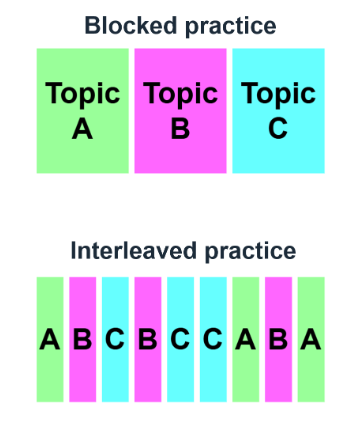
Image: Blocked and interleaved practice
Blocked practice involves practising the same type of problem or skill in a continuous block, allowing students to focus on learning and consolidating a single procedure at a time.
Interleaved practice is often more challenging for learners and is typically introduced after students have learned the underlying content. Research suggests that interleaving can have an even greater learning benefit when the concepts or problem types being mixed are closely related or look similar – for example, perimeter and area, or squaring (x2) and multiplying by 2 (2x).
Benefits of interleaved practice
- Enhances strategy selection – students must first identify what each problem is asking, and then choose the appropriate method, reinforcing when to apply each strategy.
- Deepens understanding – mixing related problem types helps students notice key features, distinguish between similar-looking questions, and develop a deeper understanding of underlying concepts.
- Supports retention over time – alternating between problem types reduces reliance on memorised patterns and introduces spacing, requiring students to repeatedly retrieve and discriminate between procedures, which strengthens long-term memory.
Examples of interleaved practice
The following examples highlight how interleaving requires students to discern what needs to be done, then recall and apply different procedures across similar-looking tasks.
Question 1
Question 2
Question 3
Acknowledgement: ‘Same surface, different deep structure’ (SSDD) task design was developed by UK maths educator Craig Barton.
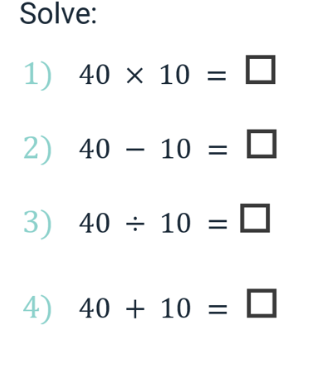
Question 1 uses interleaving by alternating between the four operations, requiring students to recall and carry out a different procedure for each part. By keeping the numbers constant, the focus remains on the operation and how each one changes the result.
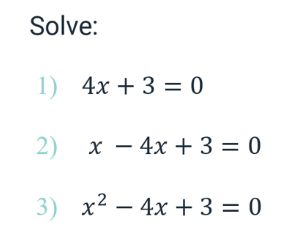
Question 2 uses interleaving by presenting three similar-looking equations that require different solution strategies, prompting students to identify the structure of each one and recall and apply the appropriate procedure.
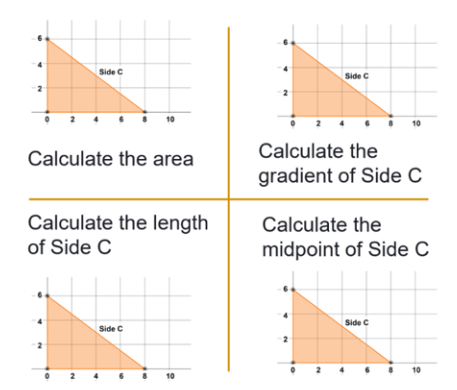
Question 3 uses interleaving by presenting a set of questions that look the same but require a different mathematical process to solve. By keeping the visual context constant, the focus shifts to identifying what is being asked, and then recalling, selecting and carrying out the appropriate procedure. Note: This ‘Same surface, different deep structure’ (SSDD) task design was developed by UK maths educator Craig Barton.
These three examples show how interleaving can strengthen students’ ability to recognise what each problem is asking and then retrieve the appropriate procedure, supporting more fluent and independent problem solving.
Implementing retrieval practice
Retrieval practice is most effective when it is planned and routine, rather than occasional. In classrooms, this often means building short, structured review opportunities within lessons and revisiting learning at increasing intervals over time.
There is no fixed rule for how often students should review learning or how far apart reviews should be spaced. Instead, the timing and frequency of review should be based on students’ age and stage of schooling; the type and complexity of the learning; and how long it has been since the learning was taught. Each review should also consider how many previous review opportunities students have had, and the learning needs of the class.
A commonly recommended routine is to review:
- new content during the lesson
- content from the previous lesson at the beginning of the next lesson
- content from the previous week at the beginning of each week
- selected content from the prior month at the beginning of each new month.
Over time, consistently applied review cycles help keep essential knowledge and procedures accessible, reducing the need for re-teaching and freeing up lesson time for new learning.
Effective retrieval practice does not rely on one-off activities, but on consistent routines that are designed, reviewed and improved over time. When teachers use student responses to adjust questions, revisit key learning and refine lesson sequences, retrieval practice becomes a practical tool for strengthening long-term retention and supporting fluent application in mathematics.