
reSolve: Modelling motion – Year 7
This sequence of seven lessons challenges students to use simple equipment to predict, observe and represent motion. They create a series of graphs to represent motion and construct instruments to measure forces in one and then two dimensions. They interpret these representations to develop concepts of force and motion. Each lesson is outlined in detail including curriculum links, vocabulary, materials needed, sample answers, discussion points and student resources. This sequence is part of the reSolve: Maths by Inquiry program.
- Resource details
- Year level
- Year 7
- Purpose
- Teaching resource
- Strand
- Number Statistics Measurement
- Topic
- Data representation and interpretation Decimals Operating with number Using units of measurement Linear relationships
- Audience
- Teachers
- Format
- Downloadable resource
- Numeracy progression
- Measuring time (P7) Number patterns and algebraic thinking (P7) Interpreting and representing data (P6) Additive strategies (P10) Interpreting fractions (P8) Multiplicative strategies (P10) Number and place value (P10) Proportional thinking (P2)
- Publisher
- reSolve Maths by Inquiry
- Copyright
- © Australian Government Department of Education, Skills and Employment 2021. Creative Commons BY-NC-SA 4.0.
- Keywords
- decimal division reasoning data analysis
- Other terms
- multiplication
Related resources
-
Estimation and rounding
Students build estimation and rounding skills by working with decimals and significant figures.
Resource details -
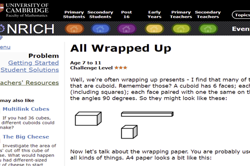
All wrapped up
What is the largest cuboid you can wrap in an A3 sheet of paper? This is a challenging problem, but suits a variety of working styles.
Resource details -
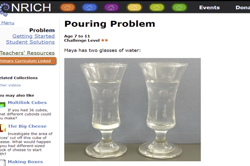
Pouring problem
This task has been designed to stimulate learners' curiosity and explain what they know about capacity and volume.
Resource details -
Volume and its units of measurement
This resource for both teachers and students focuses on finding the volume of rectangular prisms, the units of volume and capacity, and understanding the connection between volume and capacity.
Resource details -
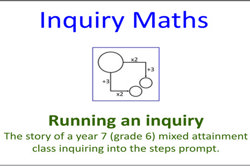
Steps inquiry
This prompt invites students to place a number in the larger circle and calculate the results of taking the steps in the two paths.
Resource details -
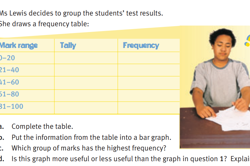
Represent collected data: Year 7 – planning tool
This planning resource for Year 7 is for the topic of Represent collected data.
Resource details -
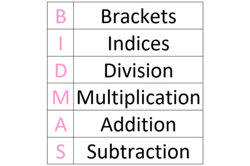
All operations: Year 7 – planning tool
This planning resource for Year 7 is for the topic of All operations.
Resource details -
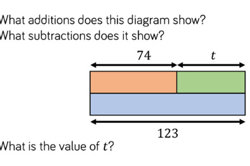
Linear expressions and equations: Year 7 – planning tool
This planning resource for Year 7 is for the topic of Linear expressions and equations.
Resource details