
Please note: This site contains links to websites not controlled by the Australian Government or ESA. Read more in the Terms of Use.
reSolve: Circumference
This sequence of three lessons explores the properties of circles, in particular the relationship between the diameter and circumference. In the first lesson, students use a cylinder containing three tennis balls to understand that a circumference is 'three and a bit' times the diameter. They then complete five different activities measuring circular objects to determine a more accurate value for pi (π). Finally, students are given a range of investigation activities to consolidate their learning. Each lesson is outlined in detail including curriculum links, vocabulary, supporting PowerPoint presentations, materials needed, sample answers, discussion points and student resources. This sequence is part of the reSolve: Mathematics by Inquiry program.
- Resource details
- Year level
- Year 7
- Purpose
- Teaching resource
- Strand
- Space
- Topic
- Shapes and objects Angles and geometric reasoning
- Audience
- Teachers
- Format
- Downloadable resource
- Australian Curriculum code
- AC9M7M03
- Numeracy progression
- Understanding units of measurement (P9)
- Publisher
- reSolve Maths by Inquiry
- Copyright
- © Australian Government Department of Education, Skills and Employment 2021. Creative Commons BY-NC-SA 4.0.
- Keywords
- pi (Ï€) radius
Related resources
-
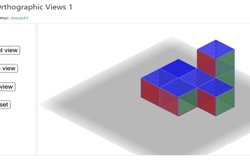
Orthographic views
Views of a three-dimensional object from different directions.
Resource details -
Geometric drawing
This resource provides detailed explanations of the curriculum content, worked examples and assessment questions related to drawing representations of solid objects.
Resource details -
Circles
This resource, focusing on the features of a circle and finding the area of a circle, gives detailed explanations of the curriculum content, worked examples and assessment questions.
Resource details -
Parallel lines and the angle sum of a triangle
This resource focuses on drawing representations of solid objects, and gives detailed explanations of the curriculum content with worked examples and assessment questions.
Resource details -
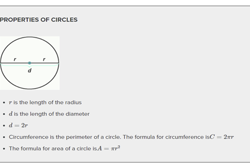
Using the properties of a circle to solve problems
This resource describes how the formulas for the surface area and volume of a cylinder are derived, shows a worked example and sets problems for students to work through.
Resource details -
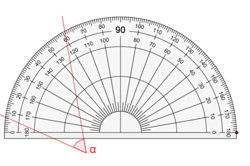
Shapes and objects: Year 7 – planning tool
This planning resource for Year 7 is for the topic of Shapes and objects.
Resource details -
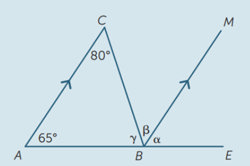
Angles and parallel lines: Year 7 – planning tool
This planning resource for Year 7 is for the topic of Angles and parallel lines.
Resource details -
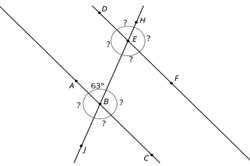
Alternate interior angles: Preparation
This is the first of a series of lessons that explore angles and parallel lines using dynamic geometry.
Resource details