
Please note: This site contains links to websites not controlled by the Australian Government or ESA. Read more in the Terms of Use.
Parallel lines and related angles
This GeoGebra applet interactive allows students to move the lines and observe the changes to the angles in and around the parallel lines. The task reinforces mathematical vocabulary and asks students to draw conclusions about the intersection of the transversal and parallel lines.
- Resource details
- Year level
- Year 7
- Purpose
- Teaching resource
- Strand
- Space
- Topic
- Angles and geometric reasoning
- Audience
- Teachers
- Format
- Interactive
- Numeracy progression
- Understanding geometric properties (P6)
- Publisher
- GeoGebra
- Copyright
- © 2021 GeoGebra. Free-for-education material.
- Keywords
- corresponding angles alternate angles transversal
Related resources
-
Circles
This resource, focusing on the features of a circle and finding the area of a circle, gives detailed explanations of the curriculum content, worked examples and assessment questions.
Resource details -
Parallel lines and the angle sum of a triangle
This resource focuses on drawing representations of solid objects, and gives detailed explanations of the curriculum content with worked examples and assessment questions.
Resource details -
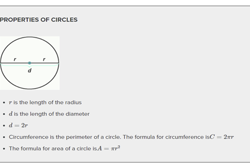
Using the properties of a circle to solve problems
This resource describes how the formulas for the surface area and volume of a cylinder are derived, shows a worked example and sets problems for students to work through.
Resource details -
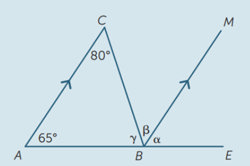
Angles and parallel lines: Year 7 – planning tool
This planning resource for Year 7 is for the topic of Angles and parallel lines.
Resource details -
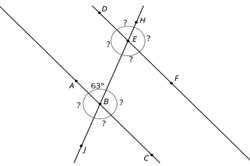
Alternate interior angles: Preparation
This is the first of a series of lessons that explore angles and parallel lines using dynamic geometry.
Resource details -
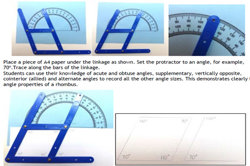
reSolve: Mechanical linkages – angles and lines
This is a series of inquiry-based lessons about angles, using folding as a context.
Resource details -
True meaning of π (pi)
This activity gives a visual representation of the relationship between the circumference and diameter of a circle.
Resource details -
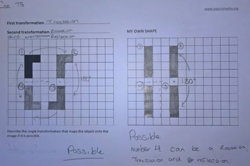
Combined transformations inquiry
Investigating combinations of translations, reflections and rotations and describing on the Cartesian plane using coordinates. Identify line and rotational symmetries.
Resource details