
Please note: This site contains links to websites not controlled by the Australian Government or ESA. Read more in the Terms of Use.
Multiple activities to engage students
In this AITSL video, the teacher uses a number of techniques to facilitate student learning in the lesson. These include a physical warm-up that relates to the content being taught – in this instance, pattern recognition. The teacher uses revision of familiar content to scaffold the teaching of new content.
- Resource details
- Year level
- Foundation Year 1 Year 2 Year 3 Year 4 Year 6 Year 7 Year 8 Year 9 Year 10
- Purpose
- Teaching strategies Professional learning
- Audience
- Teachers
- Format
- Webpage
- Publisher
- AITSL
- Copyright
- © 2013 Australian Institute for Teaching and School Leadership Limited (AITSL). Free-for-education material.
- Australian Professional Standards for Teachers
- APST 2.1: Content and teaching strategies of the teaching area
Related resources
-
Episode 38: Making a Connection to Culture
This podcast episode features Professor Chris Matthews talking about the connection between mathematics and Aboriginal culture.
Resource details -
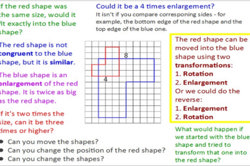
Enlargement
To enlarge and transform geometrical shapes.
Resource details -
FISO case study – smooth transitions at Bass Valley Primary School
A case study of a program implemented to address low-level literacy and numeracy skills.
Resource details -
Dylan Wiliam – collaborative learning
In this video Dylan Wiliam discusses the power of collaborative learning.
Resource details -

Pyramid inquiry
Using rules to determine the area, perimeter and height of pyramids, while also becoming aware of the features of pyramids.
Resource details -
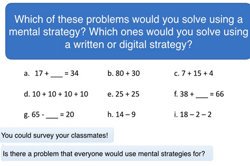
Which would you do in your head?
This video examines different ways of solving addition and subtraction problems.
Resource details -
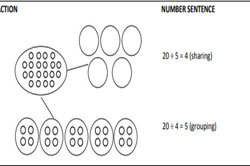
How many clumps?
This series of lessons develops students' skills, knowledge and processes of multiplicative thinking, incorporating a First Nations perspective.
Resource details -
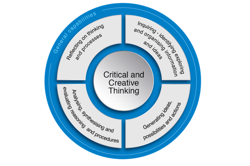
Critical and creative thinking
This resource describes key ideas for critical and creative thinking that are organised into four interrelated elements in the learning continuum.
Resource details