
Please note: This site contains links to websites not controlled by the Australian Government or ESA. Read more in the Terms of Use.
How many quads?
In this lesson students revise and extend fluency of recall of the 4× facts. Students develop proficiently in multiplying and dividing by four, understanding the patterns in multiples of four, and applying strategies for mental multiplication with an emphasis on visual and numerical pattern recognition.
- Resource details
- Year level
- Year 4
- Purpose
- Teaching resource
- Strand
- Algebra
- Topic
- Patterns and algebra Multiplication and division
- Audience
- Teachers
- Format
- Downloadable resource
- Australian Curriculum code
- AC9M4A02
- Numeracy progression
- Multiplicative strategies (P6)
- Publisher
- Queensland University of Technology
- Copyright
- © Queensland University of Technology. Creative Commons BY-NC-SA 4.0.
- Keywords
- multiplication facts
- Other terms
- YuMi Deadly
- File type
- File size
- 0.4 MB
Related resources
-

reSolve: Assessing reasoning – Year 4 exemplars
Three exemplar tasks designed to assess mathematical reasoning in Year 4, with supporting notes and annotated work samples.
Resource details -
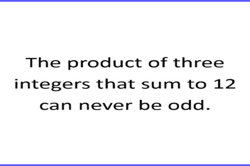
Sum and product of integers inquiry
This prompt sets up a conjecture involving products and sums for the students to explore.
Resource details -
Patterns and number facts: Year 4 – planning tool
This planning resource for Year 4 is for the topic of Patterns and number facts.
Resource details -
Efficient strategies: Year 4 – planning tool
This planning resource for Year 4 is for the topic of Efficient strategies.
Resource details -
Multiplication: Trays of arrays
Students learn to use the properties of multiplication to solve multiplication problems which are represented as an array.
Resource details -
Act it out
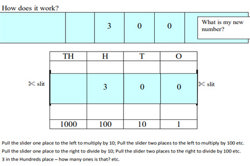
Students develop their understanding of multiplying and dividing by 10/100. They apply this strategy to find the missing element in number patterns and solve worded problems.
Resource details -
Multiplicative thinking (14 lessons)
In this sequence of 14 lessons, students learn to multiply using known facts, break numbers apart, and use strategies like distributive property and area models to solve problems.
Resource details -
Developing flowcharts: Halving strategy
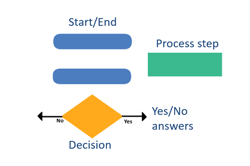
In this lesson, students will create a flowchart outlining the sequence of steps required when using the halving strategy for division. The process of creating the flowchart consolidates the sequential steps required when solving problems and can be found in other learning areas, such as Design and Technologies and Digital Technologies.
Resource details