
Please note: This site contains links to websites not controlled by the Australian Government or ESA. Read more in the Terms of Use.
Finding side lengths of triangles
A series of tasks to help students understand the basics of the Pythagorean theorem, which describes the relationship between the side lengths of right-angled triangles.
- Resource details
- Year level
- Year 9
- Purpose
- Student activities
- Strand
- Space
- Topic
- Angles and geometric reasoning
- Audience
- Students
- Format
- Webpage
- Australian Curriculum code
- AC9M9M03
- Numeracy progression
- Understanding geometric properties (P7) Understanding units of measurement (P10) Proportional thinking (P7)
- Publisher
- Illustrative Mathematics
- Copyright
- © 2017-2019 by Open Up Resources. Creative Commons BY 4.0.
Related resources
-
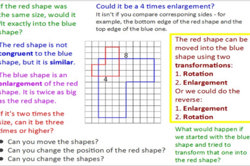
Enlargement
To enlarge and transform geometrical shapes.
Resource details -
Similar triangles
This resource provides an explanation of the rules for triangles to be similar. The resource includes downloadable worksheets for students.
Resource details -
Similarity
This resource focuses on the rules for similarity and the transformation of enlargement, with detailed explanations, worked examples and assessment questions.
Resource details -
Similarity: Enlargements
This resource explains the concepts of similarity and enlargement.
Resource details -
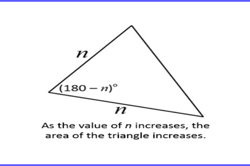
Area of a triangle inquiry
This prompt extends students' thinking about the area of a non-right-angled triangle.
Resource details -
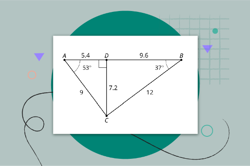
Geometry: Similarity
In this unit, students use dilations and rigid transformations to justify triangle similarity theorems. The unit balances a focus on proof with a focus on using similar triangles to find unknown side lengths and angle measurements.
Resource details -
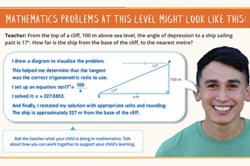
Year 9 mathematics at school: What to expect
Find some great ideas in this guide to support your Year 9 child with mathematics and numeracy learning at home.
Resource details -
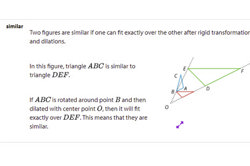
What is similarity?
A series of lessons that explores the meaning of similarity and how shapes can be translated to prove they are similar.
Resource details