
Please note: This site contains links to websites not controlled by the Australian Government or ESA. Read more in the Terms of Use.
Enlargement
A series of lessons designed to build and extend student knowledge on how shapes are transformed and enlarged using various scale factors. A variety of support material is provided to assist with teaching and scaffolding the lessons. The inquiry is structured around student questions and worked examples, and is designed to encourage students to work collaboratively to build mathematical knowledge and to extend themselves. Students are provided with an assessment task where they have the option to choose between three inquiry questions. Students then use their prior knowledge from previous lessons to work through their chosen question. Additionally, downloadable resources are provided to assist with teaching the topic.
- Resource details
- Year level
- Year 9
- Purpose
- Assessment advice Assessment tasks Planning Teaching resource Teaching strategies Student activities
- Strand
- Space Measurement
- Topic
- Proportion, rates and ratios Shapes and objects Angles and geometric reasoning Position and location
- Audience
- Teachers
- Format
- Downloadable resource
- Australian Curriculum code
- AC9M9M03
- Numeracy progression
- Understanding units of measurement (P10) Understanding geometric properties (P7) Proportional thinking (P7)
- Publisher
Inquiry Maths
- Copyright
© Andrew Blair 2012-21. Creative Commons BY-NC-SA 4.0.
Related resources
-
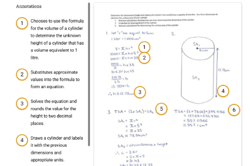
WS02 - Cylinder volume
Use this work sample to guide assessment of students' knowledge and skills in applying formulas to solve problems involving the surface area and volume of cylinders.
Resource details -
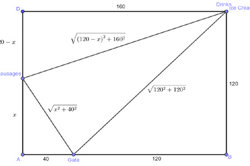
reSolve: Geometry – lunch lap (Trial)
Two inquiry-based lessons where students are challenged to use Pythagoras' theorem to optimise the path of a lunch cart.
Resource details -
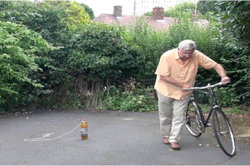
reSolve: Mathematical modelling – cornering
This series of inquiry-based lessons uses properties of circles, trigonometry and Pythagoras' theorem to investigate how long vehicles 'cut corners' when cornering.
Resource details -
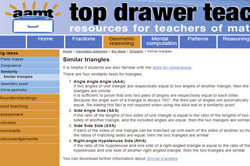
Similar triangles
This resource provides an explanation of the rules for triangles to be similar. The resource includes downloadable worksheets for students.
Resource details -
Similarity
This resource focuses on the rules for similarity and the transformation of enlargement, with detailed explanations, worked examples and assessment questions.
Resource details -
Introductory congruence
This resource describes what congruence is and how to test for it.
Resource details -
Similarity: Enlargements
This resource explains the concepts of similarity and enlargement.
Resource details