Anchors on the same page

You can use anchors to content on the same page or navigate the user to a section of content on a different page.

To navigate to the Quotes section on this page, go to the quotes section, open settings, write 'quote_section' in the 'Anchor Name' field. Then hyperlink text as you normally would but instead of hyperlinking to a page, add 'quote_section' to the anchor/query string section. In the Link title field write 'Navigates to Quotes section'


Anchors on a different page

To navigate to a section of another page, go to the section you want to link to on that page, open settings, write 'Freeonlinecourses' in the 'Anchor Name' field. Then hyperlink text as you normally would using the picker to choose the page, and in addition add 'Freeonlinecourses' to the anchor/query string section. In the Link title field write 'Navigates to Free online courses'  Eg - Have a look at our free online courses.


Quotes

‘…students become numerate as they develop the knowledge and skills to use mathematics confidently across other learning areas at school and in their lives more broadly. Numeracy encompasses the knowledge, skills, behaviours and dispositions that students need to use mathematics in a wide range of situations. It involves students recognising and understanding the role of mathematics in the world and having the dispositions and capacities to use mathematical knowledge and skills purposefully.’

(ACARA, 2017)


If students spend most of a lesson watching someone else do the math and then duplicate what that person does, then they are unlikely to see how a new idea connects to their prior learning or to generate their own conjectures relevant to the topic at hand.

(Allen & Schnell 2016)


Read more hidden section

Add text as you normally would here.

If you want the next section to be hidden and only expanded when the user clicks the hyperlinked 'Read more', check out the html source code.

This text is shown only when the user has expanded the content by clicking the hyperlinked 'Read more' above.

Replace the text "Read more about the Planning tool" in the html code with something relevant to the page.

Design element 1

Mathematics surrounds everyone in their everyday lives, but for many it can seem invisible.

Viewing the world through ‘Maths Eyes’ provides excellent opportunities to see – and actively look for – maths in the real world.

Maths Eyes is based on the idea that if individuals are supported to look at familiar things in their environment through a ‘maths lens’, they will begin to see that mathematics is all around them and this will help them build confidence in their own ability to use mathematics.

When students have Maths Eyes they become more confident in their own proficiency in mathematics and begin to regard themselves as a maths person (https://haveyougotmathseyes.com).

Maths Eyes Australia logo
Out of the classroom and into the real world. Use Maths Eyes to support students to see the maths in everyday life.

Responsive video code in a grid

View these custodians who share their Indigenous Knowledges (IK) about Connections to Country/place. When considering the Goompi model, the IK contexts presented in the video represent the Reality part of the four-part model.


Video in text section

Watch the video below with your students (full screen recommended).

Video duration: 4 min 29 sec

Design element 2

Why is maths important?

Maths has been integral to our progress as a species and will help us solve some of the biggest challenges that lay ahead.

Why maths is important in the modern world

Imagine a world without maths.

No counting, no measuring, no algorithms. No calendars, no money, no computers.

How would we build safe shelters? How would we produce enough food? Fight diseases? Travel or communicate across long distances? If you or your child has ever wondered why maths is important, think of what we would struggle to achieve without it.

Maths has been integral to our progress as a species. Ever since we first started counting, maths has helped us to understand the world around us. Without maths, we would never have built the pyramids, mapped the stars, learnt to navigate or created the first vaccine. 

Maths is everywhere, but we take it for granted. Yet we will need it to solve all of the biggest challenges facing the world today.

Decorative image

No counting, no measuring, no algorithms. No calendars, no money, no computers.

Design element 3

1. Personal finance

When you use this class, you need to have article-textimage-1 added to Settings/Custom Css Class.   Vestibulum dignissim, sem eu suscipit elementum, magna nisl accumsan libero, viverra dictum ipsum augue quis purus. Suspendisse interdum diam sit amet rhoncus maximus.

2. The built environment

Lorem ipsum dolor sit amet, consectetur adipiscing elit. Quisque rhoncus, dolor ut tristique elementum, ligula nibh lobortis odio, nec semper est ligula eu quam. Vestibulum dignissim, sem eu suscipit elementum, magna nisl accumsan libero, viverra dictum ipsum augue quis purus. Suspendisse interdum diam sit amet rhoncus maximus.
Design element 4

When you use this design element you need to ensure you have featured-article noted in settings/Custom Css Class.


Go to article
Decorative image

Design element 5

Emerging careers where maths skills are in high demand

When you use this section you need to go to settings on this content clock and add at anchor ID (article-twocolleft-1) to anchor name.

Go to article

Employers who value maths skills

Did you know that maths graduates are in demand in all kinds of industries? From finance and tech to insurance, accounting and health, here is a list of employers who value maths skills. 

Go to article

Role models to inspire young people into careers with maths

Here are five people working in surprising careers in maths. This article helps you understand the wide range of careers that rely on maths skills and are in high demand.

Go to article

Tables

Upcoming webinars


Date Topic Sign up
Tuesday 10 March, 4:30-5PM (UTC+10:30)

Celebrate International Pi Day!

Join our fast paced 30-minute webinar to explore the wonder and real world power of π (3.14). Discover why Pi matters and try hands-on activities you can use immediately in primary or secondary classrooms. A fun, creative way to make Pi Day unforgettable!

Presented by: Maths in Schools Team - Sue Carter & Dr John West

Register

Double bullets

  • When students have completed redrawing their chosen flag teacher removes the Flags of Asia map (slide 4).
  • In pairs, students play a ‘barrier’ game using mathematical language to get their partner to redraw their chosen flag without looking at it. Students instruct their partner to complete this task again using a 6 x 4 grid or rectangle. See below for example for drawing the national flag of India:
    • Begin with a rectangular shape that is 6 x 4 (provided on reverse of worksheet).
    • Divide the rectangle into three equal horizontal stripes.
    • Colour the top stripe saffron, the middle one should be white, and the bottom stripe should be green.
    • Ensure that each stripe is one-third of the total height.
    • In the centre of the middle white stripe, draw a navy blue circle to represent the Ashoka Chakra.
    • The Ashoka Chakra should have 24 equally spaced spokes or lines radiating from the centre.
    • The flag from Nepal would not be a good choice for this activity.

Adding longer descriptive text when the image needs more characters than can be included in the alt text field

Use aria-describedby and the title text within that needs to be unique to the page and can't include any spaces.  You still need to add a shortened version of the description in the alt text field.

A 5x5 grid is on a yellow background.

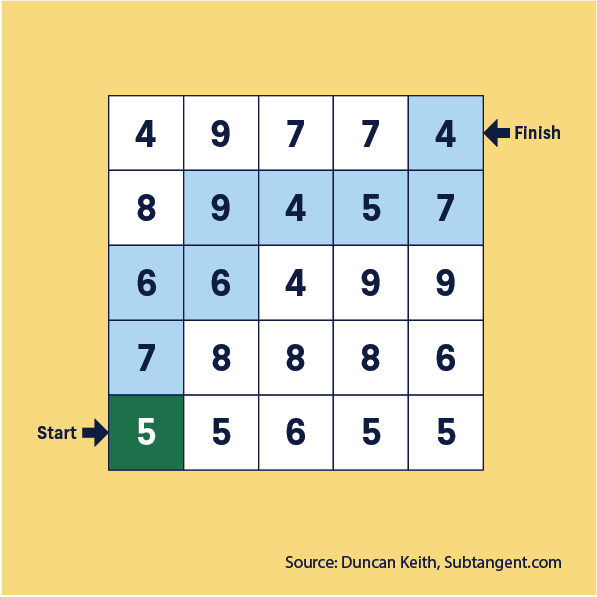
A 5x5 grid is on a yellow background. Each grid square contains a number. On the bottom row, the first square on the left-hand side, is shaded green, contains the number five and is labelled ‘Start’ with an arrow. The following numbers on the squares are: 5, 6, 5, 5. On next row above, has squares with numbers: 7, 8, 8, 8, 6. On next row above, has squares with numbers: 6, 6, 4, 9, 9. On next row above, has squares with numbers: 8, 9, 4, 5, 7. On the top row the numbers in squares are: 4, 9, 7, 7. With the last square shaded in green with the number 4 and labelled ‘Finish’ with an arrow.

How did you go? Here is one solution:

5 + 7 + 6 + 6 + 9 + 4 + 5 + 7 + 4 = 53


A 5x5 grid is on a yellow background. Each grid square contains a number. On the bottom row, the first square on the lefthand side, is shaded green, contains the number five and is labelled ‘Start’ with an arrow. The following numbers on the squares are: 5, 6, 5, 5. On next row above, has squares with numbers: 7, 8, 8, 8, 6. The squares containing 9,4,5,7 are shaded in blue. On next row above, has squares with numbers: 6, 6, 4, 9, 9. The squares containing 6 are shaded in blue. On next row above, has squares with numbers: 8, 9, 4, 5, 7. The square containing 7 is shaded in blue. On the top row the numbers in squares are: 4, 9, 7, 7. With the last square also shaded in blue with the number 4 and labelled ‘Finish’ with an arrow.

Links

Testing accessible inline links


Internal link opening in the same page

See Understanding Maths


Internal or External links that open on a new page:

Australian Curriculum (opens external website in a new window)