
Please note: This site contains links to websites not controlled by the Australian Government or ESA. Read more in the Terms of Use.
Volume of a pyramid and a cone
A proof of the formula for the volume of a pyramid and a cone using the ancient Chinese Yangma.
- Resource details
- Year level
- Year 10
- Purpose
- Teaching resource Student activities
- Strand
- Measurement
- Topic
- Area, volume and surface area
- Audience
- Teachers
- Format
- Webpage
- Australian Curriculum code
- AC9M10M01
- Numeracy progression
- Understanding geometric properties (P7)
- Publisher
- NRICH
- Copyright
- © 1997-2021 University of Cambridge. Free-for-education material.
- Keywords
- area cylinder nets surface area
Related resources
-
Geometry of water sources and landforms
Develop an understanding of Aboriginal and Torres Strait Islander Peoples’ deep connection to water, and explore how mathematics supports survival, culture, and caring for Country.
Resource details -
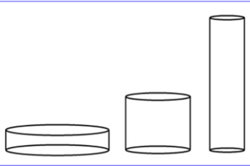
Volume of a cylinder inquiry
This prompt will challenge students to explore their understanding of integers and the volume of cylinders.
Resource details -
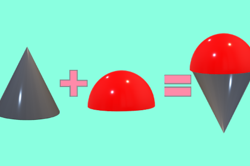
Volume and surface area: Year 10 – planning tool
This planning resource for Year 10 is for the topic of Volume and surface area.
Resource details -
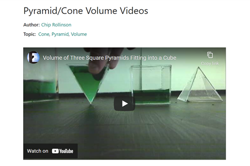
Pyramid and cone volume videos
These two videos help students discover the formulas for the volume of a pyramid and cone.
Resource details -
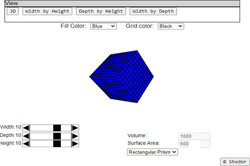
Surface area and volume
Students work through the problem to design an elephant enclosure. (Note: some of the measurements are given in imperial units and will need to be adjusted.)
Resource details -
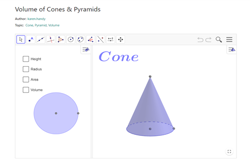
Volume of cones and pyramids
Students use this interactive tool to explore the basics of solid geometry and learn more about the formulas for the volumes of pyramids and cones.
Resource details -
Solid geometry
In this unit, students practise spatial visualisation and derive volume formulas using dissection.
Resource details -
How wrong?
In this lesson, students explore the importance of measurement errors by considering the ‘coastline paradox’ and real-world applications, including in aviation, sports and space exploration. They learn how measurement errors compound in volume calculations by exploring the impact of rounding when finding the volumes of prisms and cylinders.
Resource details