
Please note: This site contains links to websites not controlled by the Australian Government or ESA. Read more in the Terms of Use.
Mathematics Year 8 work sample portfolio – ACARA
Refer to Work sample 12: number and measurement – investigating circles, and the related tasks for guidance in assessing students’ understanding of circles, including the formula to calculate the area of a circle and identifying its diameter and circumference. This work sample is for a satisfactory level. Work samples for above and below level are also available from ACARA.
- Resource details
- Year level
- Year 7 Year 8
- Purpose
- Assessment tasks
- Strand
- Measurement
- Topic
- Angles and geometric reasoning
- Audience
- Teachers
- Format
- Downloadable resource
- Numeracy progression
- Understanding units of measurement (P9)
- Publisher
- ACARA
- Copyright
- © ACARA. Free-for-education material.
- Other terms
- annotated work samples
Related resources
-
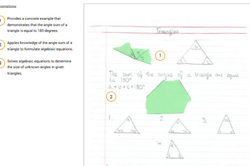
WS01 - Geometric reasoning
Use this work sample to assess students' knowledge and skills to demonstrate what they know about angles in triangles and intersecting lines with parallel lines.
Resource details -
Measuring circles
This unit consists of several lessons that introduce the geometry of circles.
Resource details -
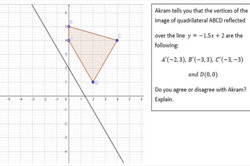
Reflections and coordinates inquiry
This prompt explores the effect of reflection in a given line on a Cartesian plane.
Resource details -
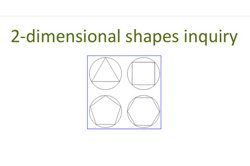
2-dimensional shapes inquiry
Investigate the relationship between the features of circles and 2D shapes. Using formulas to solve problems involving circumference and area.
Resource details -
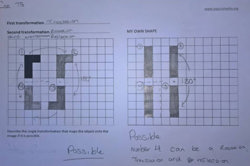
Combined transformations inquiry
Investigating combinations of translations, reflections and rotations and describing on the Cartesian plane using coordinates. Identify line and rotational symmetries.
Resource details -
Paper, pencil and protractor
In this activity, students are asked to construct triangles with a given set of restrictions. This can be done as a group activity. After completing the constructions, students are asked to explain their findings.
Resource details