
Please note: This site contains links to websites not controlled by the Australian Government or ESA. Read more in the Terms of Use.
Inquiry Maths
The Inquiry Maths website showcases a model of guided inquiry that encourages students to apply their knowledge based on a given prompt. Each activity is accompanied by detailed notes and examples from the classroom. There are lesson plans, an explanation of the model, and much more. This site is regularly updated.
- Resource details
- Year level
- Year 5 Year 6 Year 7 Year 8 Year 9 Year 10
- Purpose
- Assessment tasks Teaching strategies Teaching resource Student activities
- Strand
- Algebra Space Measurement Number Probability
- Audience
- Teachers
- Format
- Downloadable resource
- Publisher
- Inquiry Maths
- Copyright
- © Andrew Blair 2012-21. Creative Commons BY-NC-SA 4.0.
- Keywords
- reasoning proof
Related resources
-
Multiples of 1,000
A series of student tasks to understand multiples of 1000 that includes a video, quiz and exit ticket.
Resource details -
Understanding percentages
A series of student tasks to understand and apply percentages that includes a video, quiz and exit ticket.
Resource details -
Statistics
A series of student tasks to develop an understanding of angles, fractions and percentages to construct pie charts that includes a video, quiz and exit ticket.
Resource details -
Multiplying and dividing by 2-digit numbers
A series of student tasks to explore multiplying and dividing by 2-digit numbers that includes a video, quiz and exit ticket.
Resource details -
Draw, compose and decompose shapes
In this sequence of 9 lessons, students learn how to multiply numbers using a written vertical algorithm. Arithmetic sequences build progressively across year levels.
Resource details -
Comparing fractions
A series of student tasks to explore fractions that includes a video, quiz and exit ticket.
Resource details -
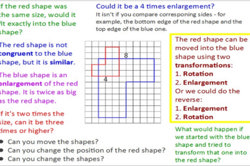
Enlargement
To enlarge and transform geometrical shapes.
Resource details -
Estimation and rounding
Students build estimation and rounding skills by working with decimals and significant figures.
Resource details