
Please note: This site contains links to websites not controlled by the Australian Government or ESA. Read more in the Terms of Use.
Congruence
The resource provides detailed explanations and examples to teach the topic of congruence. It covers the following areas: understanding the properties that determine congruence of triangles and recognising which transformations create congruent figures; constructing triangles using the conditions of congruence; and looking at the properties of quadrilaterals using congruence and angle properties. Students can use this resource independently or with peers to establish an understanding of congruence as they read through the explanations, examples and complete the questions.
- Resource details
- Year level
- Year 8
- Purpose
- Teaching strategies Student activities Teaching resource
- Strand
- Space Measurement
- Topic
- Angles and geometric reasoning Transformation Shapes and objects
- Audience
- Students Teachers
- Format
- Downloadable resource
- Numeracy progression
- Understanding geometric properties (P6, P7) Proportional thinking (P6)
- Publisher
- AMSI
- Copyright
- © Education Services Australia. Free-for-education material.
- Keywords
- rectangle triangle parallelogram
Related resources
-
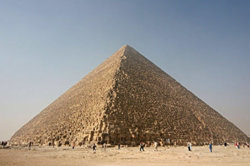
Pyramid inquiry
Using rules to determine the area, perimeter and height of pyramids, while also becoming aware of the features of pyramids.
Resource details -
reSolve: Mechanical linkages – quadrilaterals
This unit focuses on investigating geometry, starting with real-life objects, then making working models and finally using pre-prepared dynamic geometry software.
Resource details -
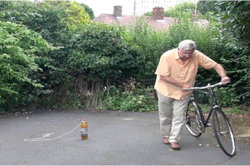
reSolve: Mathematical modelling – cornering
This series of inquiry-based lessons uses properties of circles, trigonometry and Pythagoras' theorem to investigate how long vehicles 'cut corners' when cornering.
Resource details -

Congruence of plane figures
This resource explains the meaning of congruence and demonstrates the various proofs for triangles to be congruent.
Resource details -
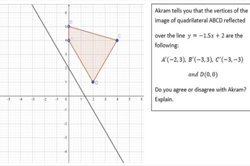
Reflections and coordinates inquiry
This prompt explores the effect of reflection in a given line on a Cartesian plane.
Resource details -
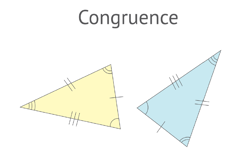
Shapes and objects: Year 8 – planning tool
This planning resource for Year 8 is for the topic of Shapes and objects.
Resource details -
Circles and cylinders: Year 8 – planning tool
This planning resource for Year 8 is for the topic of Circles and cylinders.
Resource details -
reSolve: Mathematical modelling – packaging designer
This is a series of inquiry-based lessons about creating nets for boxes that fit a given design brief.
Resource details