
Please note: This site contains links to websites not controlled by the Australian Government or ESA. Read more in the Terms of Use.
Calendar muddle
This resource gives ideas on how to talk about the calendar and when events happen. It gives examples of sentence starters, activities, vocabulary and connections to other areas of mathematics and everyday life.
- Resource details
- Year level
- Foundation Year 1
- Purpose
- Teaching resource Teaching strategies Family and carer support Family and carer activities
- Strand
- Measurement
- Topic
- Time
- Audience
- Teachers Families and carers
- Format
- Webpage
- Numeracy progression
- Measuring time (P1, P2)
- Publisher
- NRICH
- Copyright
- © 1997-2021 University of Cambridge. Free-for-education material.
- Keywords
- week event timetable
- Other terms
- day
Related resources
-
Time and duration (7 lessons)
This 7-lesson sequence covers days, months, calendars, and comparing event durations.
Resource details -
Time and duration: Year 1 – planning tool
This planning resource for Year 1 is for the topic of Time and duration.
Resource details -
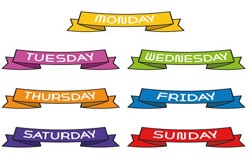
Time and duration: Foundation – planning tool
This planning resource for Foundation is for the topic of Time and duration.
Resource details -
Super Maths Quiz
The Super Maths Quiz uses random generation to create endless quizzes, allowing your students to revise core concepts at the start of each mathematics lesson.
Resource details -
My special time
Students practise telling the time to the hour and the half-hour by playing a range of engaging games and making their own analog and digital clocks.
Resource details -
How long does it take?
Students discuss and list events and activities that take small and large amounts of time. They sequence the different phases of the day and order events according to their duration.
Resource details -
Snap
Play a version of the Snap game where students use everyday language related to time as well as ordering and sequencing.
Resource details -
Location and time - Level Foundation
In this Foundation level sequence of 6 lessons, students learn about days, events, and how long things take. They explore time through sorting, talking and drawing.
Resource details