
Please note: This site contains links to websites not controlled by the Australian Government or ESA. Read more in the Terms of Use.
BitL tool
The Bringing it to Life tool describes how teachers can, by changing their style of questioning, engage students in deeper thinking and problem-solving.
- Resource details
- Year level
- Foundation Year 1 Year 2 Year 3 Year 4 Year 5 Year 6 Year 7 Year 8 Year 9 Year 10
- Purpose
- Teaching strategies Teaching resource
- Audience
- Teachers
- Format
- Downloadable resource
- Publisher
- Government of South Australia Department for Education
- Copyright
- © Government of South Australia. Free-for-education material.
- Other terms
- questioning pedagogy
Related resources
-
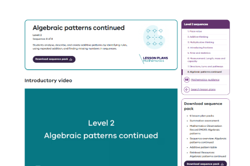
Algebraic patterns continued (6 lessons)
In this sequence of 6 lessons, students analyse, describe, and create additive patterns by identifying rules, using repeated addition, and finding missing numbers in sequences.
Resource details -
Multiples of 1,000
A series of student tasks to understand multiples of 1000 that includes a video, quiz and exit ticket.
Resource details -
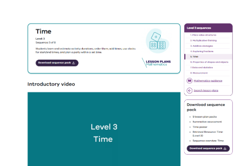
Time (9 lessons)
In this sequence of 9 lessons, students learn and estimate activity durations, order them, add times, use clocks for start/end times, and plan a party within a set time.
Resource details -
Understanding percentages
A series of student tasks to understand and apply percentages that includes a video, quiz and exit ticket.
Resource details -
Statistics
A series of student tasks to develop an understanding of angles, fractions and percentages to construct pie charts that includes a video, quiz and exit ticket.
Resource details -
Multiplying and dividing by 2-digit numbers
A series of student tasks to explore multiplying and dividing by 2-digit numbers that includes a video, quiz and exit ticket.
Resource details -
Draw, compose and decompose shapes
In this sequence of 9 lessons, students learn how to multiply numbers using a written vertical algorithm. Arithmetic sequences build progressively across year levels.
Resource details -
Comparing fractions
A series of student tasks to explore fractions that includes a video, quiz and exit ticket.
Resource details